Thursday, 10 April 2014


HUMAN NOSE ABLE TO DETECT MORE THAN 1 TRILLION SCENTS
  
You know that thing on your face, smack between your eyes and mouth, the one you use to put air in and out of your meat suit, well turns out its kind of awesome in a trillion different ways literally as scientists confirmed that the human nose can detect more than a trillion different odors.
The norse god.....or is it nose god,get it?

There had been a long-standing claim that people could detect 10,000 different scents. That estimate was way too small. The new research suggests the real number is 10,000 times bigger. Scientists had thought the old number might need revising. The new study certainly supports that.


One trillion (1,000,000,000,000) is a huge number. Imagine every person on Earth gave off 100 distinct odors all his (or her) own. A single nose might be able to tell them all apart, based on the new numbers.
Our sense of smell may be even more refined than sight or sound. People can see several million different colors and hear roughly 340,000 tones.

You my friend are out of a job . . . .the next frontier in security,the human  nose

26 men and women to visited a lab and sniff. Then to sniff, and sniff, and sniff  some more. Each person completed 264 different smell tests. Each time, the volunteers sniffed a trio of vials. Two contained the same odor. A third differed. The participants had to identify which one wasn't like the others.

Most odors in the real world contain a mix of molecules, each of which contributes some part of the final scent. Here, the scientists combined a selection of molecules to create the different scents. They chose various amounts from a group of 128 different chemicals to concoct the odors.


Based on those results, the scientists estimate that the average person can identify about a trillion different smells, each made from 30 separate odor molecules. However, the most sensitive smeller in the group could probably identify many more, the scientists say. Someone with a relatively insensitive nose would probably detect only about 80 million, they now suspect. 
The study only used 128 odor molecules; far fewer than the number that exists in the real world. As such, one trillion is likely a low estimate for a sensitive nose. As they say, with great power comes great responsibility, go out and use your powers for good, Captain nasal?


THE LIGHT AT THE END OF THE TUNNEL.....SCIENCE SAYS THERE MAY BE SOMETHING THERE AFTERALL


><><Drifting Spirit><>< - ghosts-spirits-demons Photo
pictured :the many possibilities


You  know that question you always ask yourself especially on Sunday as the priest stares you down as though you were the spawn of Lucifer?will i go to heaven or hell when i die?turns out you do have cause for concern .Many of us fear death,or should i say all of us?. It is the not knowing exactly what death is that scares us ,do the lights just go off?are we reborn as someone else?do we go to heaven?

We associate ourselves with the body, and we know that bodies die. But a new scientific theory suggests that death is not the terminal event we think that it just may be a small part in the life cycle and not the end.


One well-known aspect of quantum physics is that certain observations cannot be predicted absolutely. Instead, there is a range of possible observations each with a different probability. One mainstream explanation, the “many-worlds” interpretation, states that each of these possible observations corresponds to a different universe (the ‘multiverse’). A new scientific theory – called biocentrism – refines these ideas. There are an infinite number of universes, and everything that could possibly happen occurs in some universe. Death does not exist in any real sense in these scenarios. All possible universes exist simultaneously, regardless of what happens in any of them. Although individual bodies are destined to self-destruct, the alive feeling – the ‘Who am I?’- is just a 20-watt fountain of energy operating in the brain.


You ...in a bottle
  But this energy doesn’t go away at death. One of the surest axioms of science is that energy never dies; it can neither be created nor destroyed. But does this energy transcend from one world to the other? 


Consider an experiment that was recently published in the journal Science showing that scientists could retroactively change something that had happened in the past. Particles had to decide how to behave when they hit a beam splitter. Later on, the experimenter could turn a second switch on or off. It turns out that what the observer decided at that point, determined what the particle did in the past. Regardless of the choice you, the observer, make, it is you who will experience the outcomes that will result. The linkages between these various histories and universes transcend our ordinary classical ideas of space and time. Think of the 20-watts of energy as simply holo-projecting either this or that result onto a screen. Whether you turn the second beam splitter on or off, it’s still the same battery or agent responsible for the projection.

According to Biocentrism, space and time are not the hard objects we think. Wave your hand through the air – if you take everything away, what’s left? Nothing. The same thing applies for time. You can’t see anything through the bone that surrounds your brain. Everything you see and experience right now is a whirl of information occurring in your mind. Space and time are simply the tools for putting everything together.
Death does not exist in a timeless, spaceless world. In the end, even Einstein admitted, “Now Besso” (an old friend) “has departed from this strange world a little ahead of me. That means nothing. People like us…know that the distinction between past, present, and future is only a stubbornly persistent illusion.” Immortality doesn’t mean a perpetual existence in time without end, but rather resides outside of time altogether.
Hahaha....what?yes i do know my quotes are awesome


After the death of his son, Emerson wrote “Our life is not so much threatened as our perception. I grieve that grief can teach me nothing, nor carry me one step into real nature.”
Whether it’s flipping the switch for the Science experiment, or turning the driving wheel ever so slightly this way or that way on the highway, it’s the 20-watts of energy that will experience the result. In some cases the car will swerve off the road, but in other cases the car will continue on its way .Death is a mystery we all get to solve for at the end none can come back to give us an answer.


FROM PEA SIZE TO INFINITY SIZE.........NEW EVIDENCE 

SUPPORTS BIG BANG THEORY


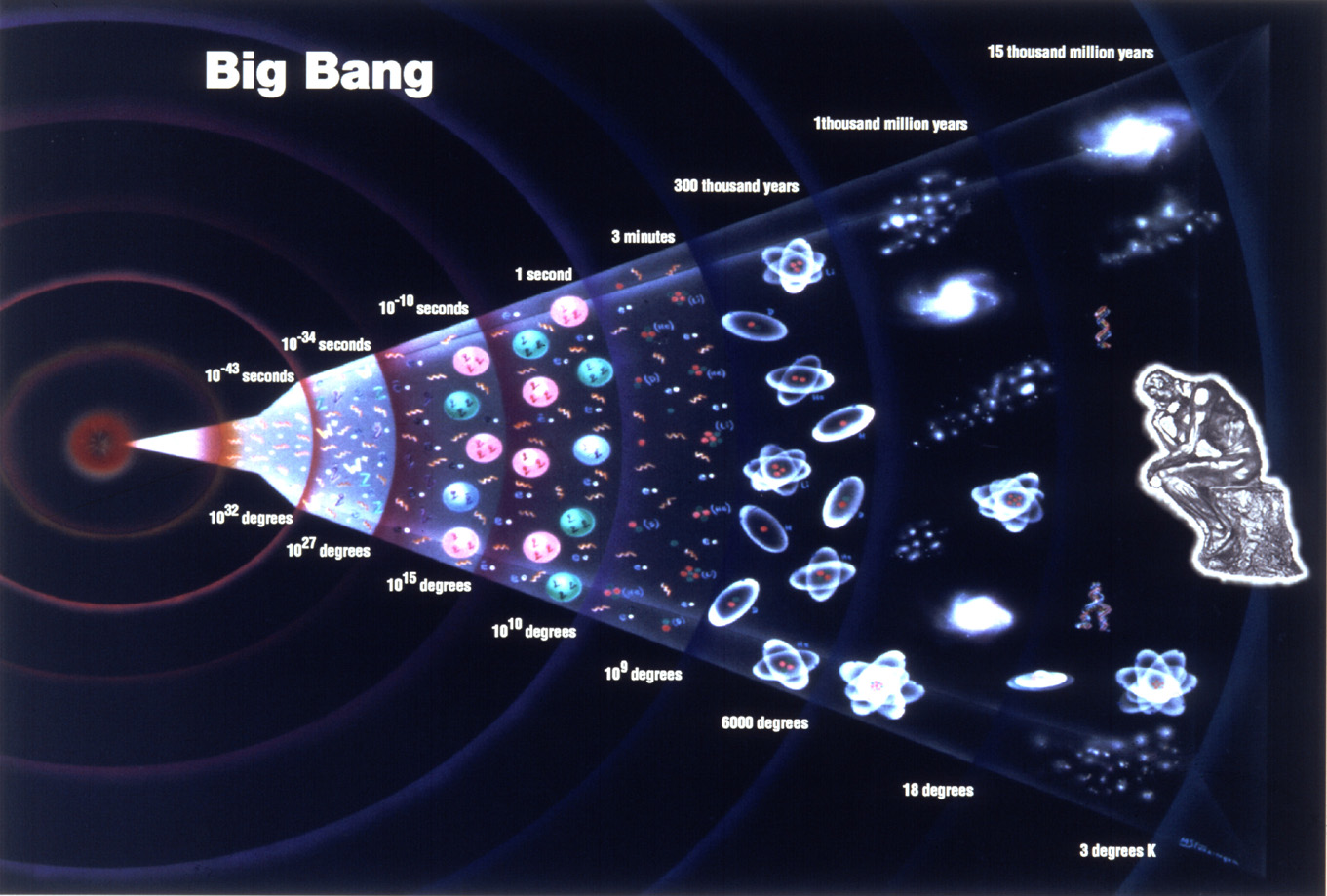
 On March 17, scientists reported finding the earliest echoes of the Big Bang, not the show. The long-sought evidence supports the idea that the universe inflated in a flash. A scientific theory, called inflation, held that during the first trillionth of a trillionth of a trillionth of a second after the Big Bang, the universe grew outward faster than the speed of light. It soon stretched out farther than any telescope can see.
Cosmologists are astronomers who study the early universe or for the simpler among us, they are archeologists but deal with space . They first introduced the theory of inflation more than 30 years ago. Since then, it's become an important part of the explanation for how the universe began. Inflation helps answer some questions raised by the Big Bang. One is why the universe looks the same in every direction. Another is why it isn't clumpier in some directions
Scientists couldn't travel back in time to the Big Bang; it was 13.8 billion years ago. But they also didn't have to. According to that inflation theory, the Big Bang sent waves rippling through the stuff of space. Known as “gravitational waves,” they would alternately squeeze and stretch the fabric of space. So their passage should have left a mark on the farthest reaches of the known universe. Scientists had sought those telltale marks.
For their search, the scientists used a telescope at the South Pole. It’s called BICEP2 (short for the Background Imaging of Cosmological Extragalactic Polarization),for nerds scientists sure do come up with catchy acronyms. 

 
( image courtesy of New York times)
For those of us thinking that a headline reading BICEP2 finds aliens would be awesome...your thoughts are warranted

By gauging the temperature of deep space, this telescope works almost like a giant thermometer. Scientists built it deep in Antarctica. The region’s cold, dry and stable air is perfect for peering deep into space — and back into time.A much better excuse than saying it is colder than hell frozen over.
For 50 years, scientists have known that energy in the form of microwave radiation lingered long after the Big Bang. BICEP2 studies this type of light. The telescope records the behavior of photons. Those particles transport radiation, like this microwave signal. The scientists report finding twists and turns in the patterns of the microwave photons. Kovac’s group now concludes that gravitational waves are the only plausible explanation for that.